What should we do if a wild boar comes toward us?
Unfortunately, we live in a very dangerous world. The media never misses a chance to rub this in our faces, since countless accidents, fires, and UFO attacks can happen to us. Lately, urban lifestyles have been pushed to extremes never seen before, and people in the concrete jungle are almost scared to death when they encounter anything natural, whether it is a weather phenomenon, some wild animal (though we are fortunate in this regard, since truly life-threatening predators do not really live here), or any wild fruit or mushroom.
It is true that in an environment where we do not know the rules, it is wise to behave cautiously, but that does not mean we should shy away from hiking and walking in nature; instead, we should find out what to do in extreme situations.
For example, what should we do if we encounter wild animals during a walk in the forest? There is no problem with deer, since they are much more afraid of humans than we are of them. It is much easier to run into trouble with deer on a road, when they jump out in front of us, than in the forest. In general, if they hear a person approaching, they slip away unnoticed; most of the time we do not even realize they were there. If the encounter is a surprise for them as well and/or they get very frightened, they may flee noisily; in such cases, the thudding of their hooves can be felt on the ground, and the rustling through the undergrowth can be heard.
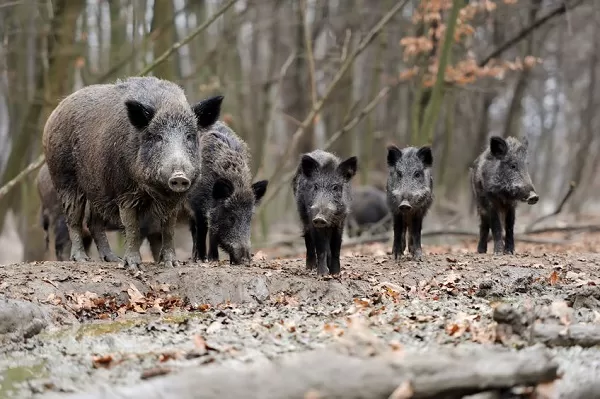
Wild boars are a different matter, because although they also try to avoid contact with humans, they may become aggressive toward us. The greatest chance of this is when they have piglets (January to May, although in fact it cannot be ruled out at any time of year). If we come across wild boars, never waste time trying to assess how many there are or what their composition is. Do not act in a threatening way by moving toward them. It is very important not to block their path or trap them in a place where they cannot escape!
If we read online about who recommends what in such a situation, we can see that there are several different “schools of thought.” Some believe that you should try to scare off the boars, meaning whistle, clang bells, or wave a stick. Others think it is not worth trying such things, because they may misinterpret it, especially if it is about mother sows, and in any case they cannot be scared away.
There are those who say you should stand still, because that is in no way threatening; others say that “running away is shameful, but useful.” The latter is contradicted by the fact that the wild boar is an extremely persistent runner, with a top speed of 45 km/h, which a person can rarely outdo.
Both actions can be challenging for them, and since we would come out worse on both counts if it came to a confrontation, it is better not to force the issue. Climbing a tree is not a solution either, since the wild boar is smart enough to stand under the tree until we get tired and fall down.
Noise-making, however, can have its place if we have not yet encountered a wild boar, but there is a chance that one is somewhere nearby. In that case, it is worth clapping and singing to let the boar know that we are coming and give it a chance to move away and avoid the encounter.
It is also very important that we do not approach the animals, even if they seem very peaceful. There is only one thing that is an even stronger taboo: if we find striped piglets alone (or perhaps discover a nest or see them under a bush), we should never, ever go near them, look at them, and especially not pet them or pick them up. No matter how helpless they may seem, believe us, they do not need help; their mother is probably just out looking for food. At the same time, we can be sure that if they detect a stranger’s presence or are lifted out of the safety of the nest, a help-seeking squeal will sound, and if the mother shows up, we will be in very serious trouble.
If we encounter an adult wild boar, there are two things we can do, and both require considerable self-control. One is to act as if we have not noticed it and, without significantly changing our pace, try to disappear from the scene. The other is to stop and wait until it leaves. In such cases, it is advisable not to make eye contact with it.
When attacking, the boar uses its tusks, while the sow bites. If we end up in a situation where a wild boar attacks us and we cannot escape, the best thing to do is curl up on our stomach. It is worth protecting our head with our arms, perhaps squeezing under a tree or bush, and keeping our internal organs safe by curling up.