Why does a marten chew through car cables?
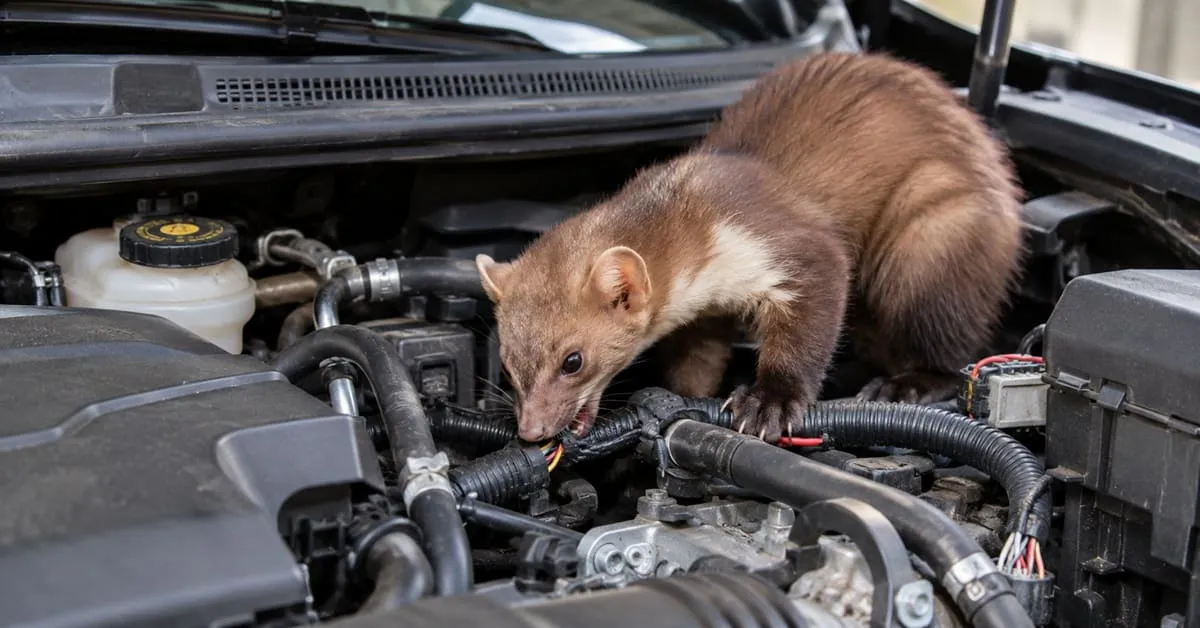
It can ruin an electrical cable in a single night, chew through the coolant hose, or tear apart the hood insulation. But why does the stone marten do this? Why is it interested at all in car parts coated in plastic and rubber, when they provide it with no food whatsoever? To answer that, it is worth getting to know the behavior of these highly adaptable animals.
First of all: the stone marten is not a rodent!
Although in everyday speech we often refer to it as a rodent, the stone marten is actually a predatory mammal belonging to the weasel family. It is not related to mice or rats, and its teeth work in a very different way. Unlike rodents, it does not have continuously growing incisors that it would need to wear down by regular gnawing.
This means that when a stone marten bites through a wire, it is not driven by the same instinct as mice or rats gnawing on cables. A stone marten can bite forcefully, but it does not do so because it needs to constantly wear down its teeth.
The two groups of animals can still cause similar damage in the engine compartment. If we are not sure which animal has been in our car, it is worth reading our previous article as well: Rodent or stone marten in the car’s engine bay: signs, damage, and prevention.
Why does the stone marten climb into a car’s engine bay in the first place?
The stone marten is one of the most successful urban small predators. Although it also occurs in natural habitats, it finds excellent shelter and food sources in human settlements. Attics, outbuildings, garages, and car engine bays can all serve as suitable places for temporary hiding.
The engine bay of a parked car can be especially attractive to it because it offers sheltered, relatively hard-to-reach nooks, and it may still be warm after use. Thanks to its flexible body, the stone marten can squeeze through surprisingly narrow openings.
The conversation made by Antal Sturcz with biologist Dr. Mária Tóth Ronkainé also mentions how skillfully martens make use of the opportunities offered by the urban environment. They do not necessarily like city noise or artificial light; they have simply learned to live with these environmental effects. But the engine bay is not just an occasional shelter. That is where the really interesting story begins.
The most important explanation: the stone marten defends its own territory
The stone marten is a territorial, meaning territory-defending animal. Competition is especially strong among males, so individuals mark places that are important to them with scent marks. If a stone marten regularly visits a parked car, it may leave scent markings there as well. In this way, the engine bay can become part of the area used by the animal.
Let’s imagine a simple situation: every evening we park our car in the same yard, where a stone marten appears regularly. From time to time, the animal crawls into the engine bay, inspects its surroundings, and then leaves scent marks behind.
The next day we drive to work and park in a completely different part of town. But there, we are in another stone marten’s territory. If this animal climbs into the car, it may encounter the scent of a stranger stone marten, right in its own territory.
The rival’s scent mark can trigger territory-defending reactions, which may be accompanied by bites and damage to components in the engine bay. This explanation is consistent not only with the territorial behavior known to biologists, but also with the experience of automobile clubs and insurers. The German ADAC automobile club specifically draws attention to bites triggered by the scent marks of unfamiliar martens.
In other words, in many cases the stone marten is not at war with the car itself, but is reacting to the presence of another stone marten. And the cables and rubber hoses are simply in the wrong place.
Why are the cables and rubber hoses bitten in particular?
Although territorial behavior is an important explanation, by itself it still does not tell us why the stone marten chooses an electrical wire from among the many components found in the engine bay. Cables, rubber hoses, and insulating materials are relatively easy to grasp, and they are usually more flexible than the surrounding metal parts. A curious, exploratory stone marten may examine objects that interest it with its mouth and teeth as well. This instinctive inspection of objects may also contribute to the damage.
So the phenomenon does not necessarily have a single cause. Territorial reactions, curiosity, and the properties of the materials in the engine bay can all play a role together.
Interestingly, there is also a theory that martens may try to make up some kind of micronutrient deficiency by gnawing on copper-containing wires. However, there is no convincing scientific evidence available for this, so it cannot be treated as a general explanation. The copper-deficiency theory is therefore not currently considered a proven cause of cable gnawing, but it was certainly mentioned as an interesting idea in the conversation referred to earlier.
In practice, martens damage not only copper-containing wires, but also coolant hoses, rubber boots, and various insulating materials, which also suggests that the phenomenon is not simply about searching for a single material.
When do most marten damages occur?
Many people think that martens pose a risk to cars mainly in winter, since a warm engine bay can be especially attractive to them at that time. Although this line of reasoning is correct, insurance damage statistics show a different picture.
According to the 2026 summary of the German Insurance Association (GDV), car damage caused by martens is especially common between April and June. The increased spring activity may also be linked to stronger territorial behavior and movements related to the breeding season. The German Hunting Association also highlights the role of increased territoriality during the summer mating season. The risky periods therefore are not limited exclusively to the cold months.
One important risk factor for gnawed cables is not the temperature, but the relationship between the animals. A stone marten can crawl into the engine bay even in winter, and car damage can occur throughout the year, but most insurance claims do not necessarily happen in the coldest months.
Why might it attack the same car again?
If a stone marten has already appeared in a car once, the risk of later damage can also be increased by lingering scent marks. That is why repairing the damaged parts alone is not necessarily enough. For example, if a stone marten has gnawed through the ignition cable and the car owner simply replaces the damaged wire, the scent markings left earlier in the engine bay may still remain. Another stone marten may react to these again and cause further damage.
That is why, after marten damage, it is also important to have the engine bay professionally cleaned, which can reduce the presence of lingering scent marks. It is best to leave the cleaning to a specialist, because modern car engine bays contain many electrical components that are sensitive to water and cleaning agents.
If the stone marten returns regularly, it is worth taking preventive measures as well, not just eliminating the consequences of the previous damage.
How can we protect ourselves once we understand the stone marten’s behavior?
Stone martens are highly adaptable animals, so keeping them away is not always easy. Dog hair, essential oils and other strongly scented home remedies may disturb them temporarily, but they do not necessarily provide long-lasting, reliable protection.
Animals can become accustomed over time to stimuli that repeat regularly and have no consequences. This habituation, or adaptation, can also be an important consideration in ultrasonic deterrents. The purpose of combining sounds with varying frequencies and light signals is to disturb the animal venturing into the engine bay with multiple kinds of stimulus. However, this alone does not guarantee that every stone marten can be kept away in every situation, but it significantly increases the chances.
Where the car’s design allows it, proper physical protection can also be useful: for example, engine-bay covers designed for this purpose or protective sleeves for individual vulnerable wires. When installing these, care must be taken not to obstruct engine cooling or the safe operation of the car.
We also covered different methods of protection in our earlier article: Are we helpless against stone martens?
Vadalarm AutoGuard: protection where the damage occurs
With knowledge of stone marten behavior, it is clear why targeted protection of the engine bay is important. We do not necessarily need to prevent a stone marten from ever climbing onto the car, but above all, we need to stop it from damaging sensitive components in the engine bay.
For this purpose, we developed the Vadalarm AutoGuard car marten and rodent repellent, which uses ultrasound with a variable frequency between 20–27 kHz and a strong, flashing white light signal.
One of the device’s biggest advantages is that it can also run on its own battery, so after secure mounting in the engine bay, it does not necessarily need to be wired to the car’s battery. It can be charged via USB-C, and in normal mode, under suitable conditions, it can run for up to three months on a single charge.
For those who want continuous, automatic operation, a 12-volt car battery connection is also possible. In this case, while the vehicle’s charging system is operating, the device charges its own battery, and when parked, it runs the deterrent from that battery.
The purpose of AutoGuard is not to harm animals, but to create unpleasant stimuli for the stone marten venturing into the engine bay, thereby reducing the chance of damage.
We cannot change the behavior of stone martens, but we can prepare our cars for their visits. Proper inspection of the engine bay, removal of scent marks, and forward-looking protection can together help avoid turning a seemingly harmless nighttime visit into a serious repair bill.