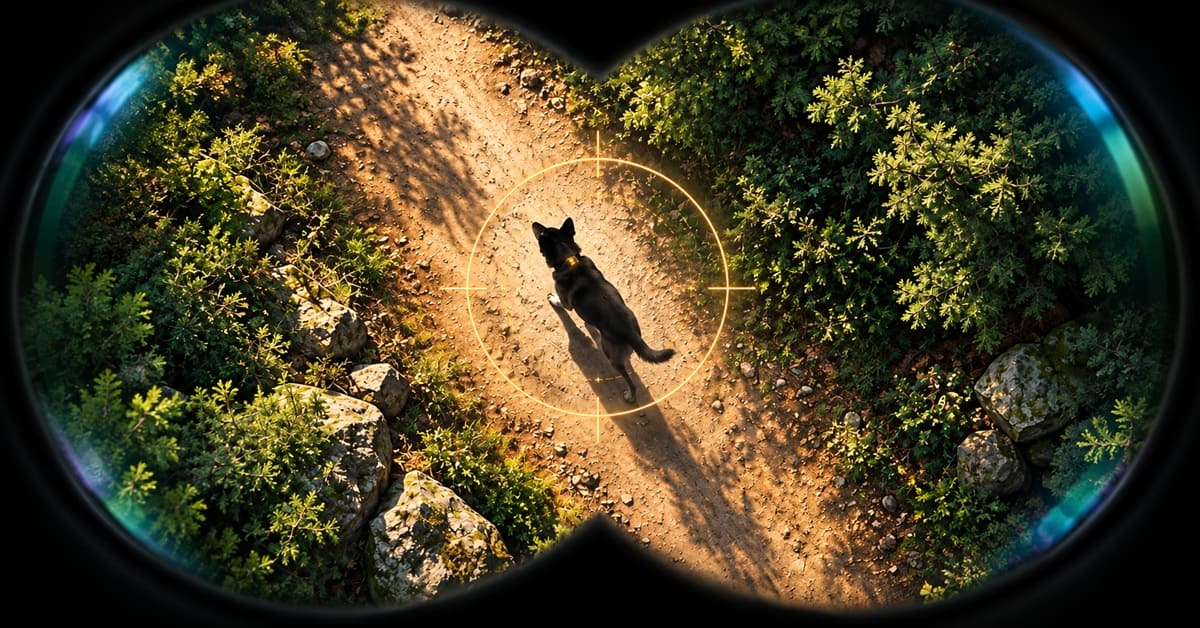
How well does the GPS tracker work in the forest?
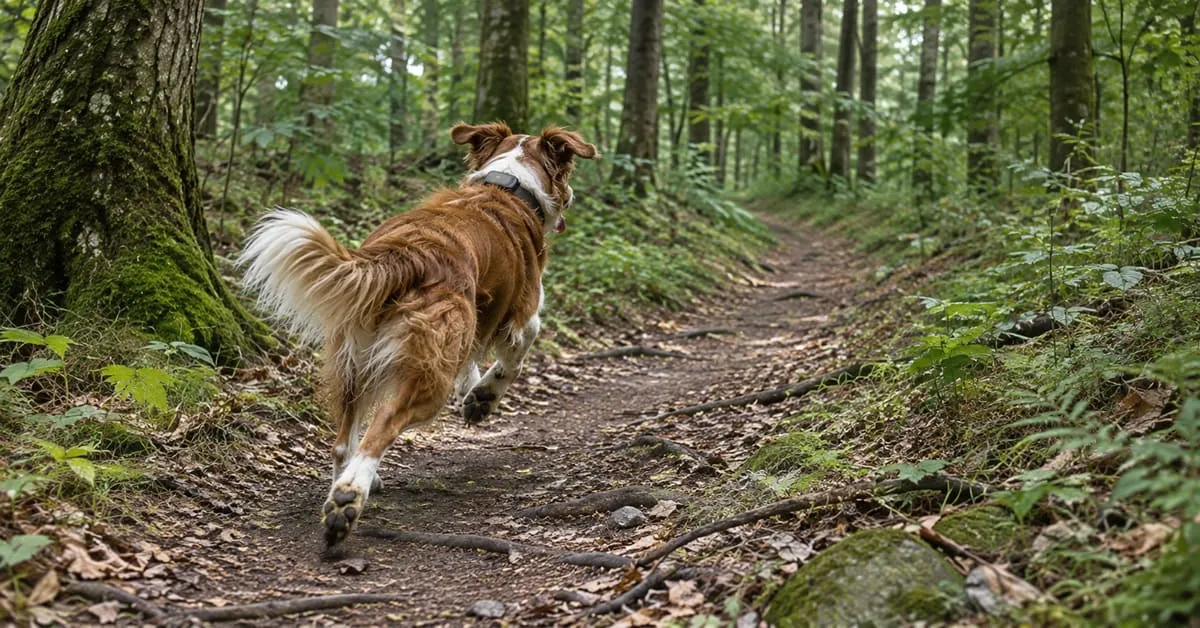
If we go hiking in the forest with our dog, it can be especially important to know exactly where our pet is in case of need. But does GPS work just as reliably under a dense canopy as it does in an open field? According to scientific research, the difference can be significant: under certain conditions, positioning accuracy can deteriorate severalfold, and in some cases, certain locations may not be detected at all. We looked into what we can expect in practice.
How accurate is GPS in the forest?
For GPS to work, the device needs to receive the radio signals of satellites. The more signals from suitably positioned satellites it can process, the more accurately it can perform the calculations needed for positioning.
In open terrain, satellite signals can reach the receiver relatively unobstructed. In the forest, however, the canopy, tree trunks, and the terrain can also weaken or reflect these signals.
In a European forestry study published in 2016, the accuracy of different GPS and GNSS devices was examined. In open terrain, accuracy of 1.90–2.36 meters was measured, while in leafy forest it ranged from 4.96 to 11.45 meters. This means that the same positioning technology can operate with several times larger errors in a forest environment.
It is important, however, that these are not accuracy limits that apply to every GPS device, but the measurement results of the devices examined in that specific study.
Can GPS completely lose track of the dog’s position?
Yes, and it is a more common phenomenon than you might think. In a Japanese study published in 2008, the performance of GPS collars that can be fitted to animals was examined under different terrain conditions in the Mount Fuji area.
In open, flat terrain, the devices successfully recorded a position in 100% of the attempted location fixes. On sloping terrain covered with dense vegetation, however, this rate was only 53%. In other words, in the latter environment, nearly half of the positioning attempts did not produce a usable position.
This does not mean that every GPS tracker made for dogs will perform exactly this way in a forest. The study was conducted with specific devices, and the results also depend significantly on the design of the receiver.
The lesson is still important: it may happen that the tracker is unable to determine a new position for a while, especially in dense forest or between steep mountainsides.
GPS can sometimes be off by several hundred meters
GPS accuracy is often characterized by a single number, for example by saying that a device is accurate to 5 or 10 meters. The reality, however, is more complex, because accuracy changes. In a 2022 New Zealand study, GPS devices developed for tracking forest animals were examined. In half of the successfully determined positions, the measurement error remained within 8.65 meters.
At first glance, that sounds like an excellent result. However, in 5% of positions, the error exceeded 271 meters, and some extreme measurements differed from the real location by more than a kilometer. The study used a special, energy-saving GPS technology, so these values cannot be generalized to commercial dog trackers. What they do show clearly, however, is that average accuracy alone does not tell the whole story about reliability.
In practice, it is therefore worth treating any unexpected map position with caution. If the dog’s marker suddenly jumps several hundred meters away, and then moves back near the original route at the next measurement, it is possible that a simple positioning error occurred.
Can GPS be more accurate in winter than in summer?
Surprisingly, yes, under certain conditions. In deciduous forests, the dense foliage in spring and summer can create an additional obstacle for satellite signals. In winter, after the leaves have fallen, reception may become more favorable.
The previously mentioned European study also examined the difference between the leafed and leafless periods. The forest positioning error ranged from 4.96–11.45 meters in the leafed period, and from 4.51–6.72 meters in the leafless period.
However, the improvement was not statistically significant for all of the devices examined. So the seasonal changes in vegetation can also affect GPS performance, but it cannot be stated in general that every tracker works more accurately in winter.
What happens if there is no mobile internet in the forest?
This is one of the most important differences to understand about how GPS dog trackers work. GPS positioning and position transmission are two separate processes.
The GPS receiver determines the device’s location based on satellite signals. It does not need mobile internet for this alone. However, most dog trackers that work with a smartphone app transmit the position to a server via the mobile network, from where it appears on the owner’s phone.
This means that two different problems can occur:
- The tracker cannot determine a proper GPS position because the satellite signals are too weak or unfavorable.
- The tracker successfully determines its location, but without a mobile network connection it cannot send the new data.
The second case can occur especially in mountainous, sparsely populated areas, where mobile network coverage is patchy.
On the phone screen, you may even see a previously recorded position, while the dog has already moved elsewhere. That is why, when using a GPS tracker, it is worth paying attention not only to where the map shows the dog, but also to when the last location data arrived.
Does it also matter how the tracker sits on the dog’s neck?
Yes, and this is also more important than you might think. In the Japanese GPS collar study, the position of the antenna also affected the success of positioning. In a forested environment, horizontal and vertical antenna orientation produced different performance.
On a dog’s collar, the device’s position can constantly change. The dog may lower its head, sniff around, and while running, the tracker may twist. All of this can affect the reception of radio signals.
That is why it is worth always attaching the GPS tracker in the way recommended by the manufacturer, and making sure it cannot easily rotate or fall off.
What should we pay attention to when heading out on a forest hike with a GPS tracker?
With a few simple precautions, we can prevent many inconveniences.
Check the device before setting out. Check the battery level, and make sure the smartphone app is actually showing a current position.
Pay attention to mobile network coverage. If we are going somewhere where there is often no signal, we should expect that live tracking may be interrupted from time to time.
Do not assume that every GPS position is centimeter-accurate. In dense forest, steep valleys, or near large rock faces, the positioning error can increase significantly.
Always check the timestamp of the last data. A location update that is ten minutes old may no longer reflect the dog’s current location, especially if the animal is constantly moving.
GPS should not replace safe dog walking. A tracker can help locate a missing animal, but it does not prevent escape, and it does not replace a leash where its use is mandatory or justified.
Which GPS tracker is worth choosing for a forest hike?
If you regularly go hiking with your dog, it is worth choosing a GPS tracker that has its own satellite positioning, mobile connectivity, and a smartphone app.
The Vadalarm Pet Tracker is designed specifically for tracking pets. It works with a built-in GPS receiver and 4G mobile connectivity, so with proper coverage we can track our dog’s location on our phone.
The device weighs just 27 grams, can be attached to a collar, and has an IP65-rated housing, while its battery typically provides 2–3 days of operating time. In the Vadalarm Smart app, both the current location and route history can be viewed.
Of course, the Vadalarm Pet Tracker is also subject to the physical limitations of satellite positioning and mobile network coverage. For forest use, it is therefore worth following the same precautions as with other GPS-based trackers. If you would like to learn more about general GPS accuracy, read our earlier article as well: How accurate is a pet GPS tracker?.
GPS is not an infallible technology, but when used properly it can be a valuable aid if we want to quickly find out which direction to head in search of our four-legged companion when we lose sight of them.