This Is How Mice and Rats Learn and Remember
Why does the mouse keep showing up at the same cabinet again and again? Why does the rat avoid the newly placed object? Learning plays an important role in rodents’ behavior: they can remember routes leading to food, react to changes in their environment, and become accustomed to certain stimuli. If you understand these processes, it becomes easier to recognize what keeps them in the house, garage, or warehouse.
Mice can quickly learn complex routes
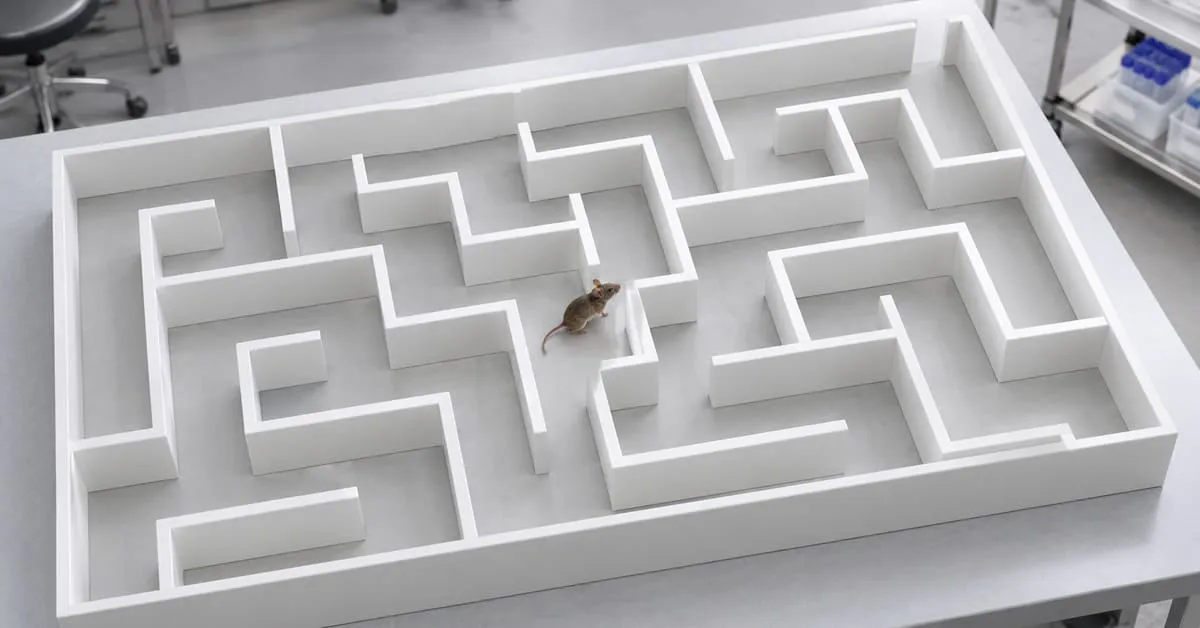
Mice’s navigation also interests researchers. Staff at Caltech studied how mice learn in a complex maze. The animals were free to explore the corridors and could find a water reward in them. The mice searching for the reward after about ten rewarded experiences learned the route leading to it, which required many decisions.
It is especially interesting that the performance of several animals improved suddenly. In this task, learning could therefore also involve a sudden change. At the same time, the researchers also observed that simple, local turning rules contributed to efficient navigation through the maze.
For home prevention, this means it is worth paying attention to recurring routes. If you regularly see fresh traces in the same place, check what that path leads to: accessible food, pet food, or an undisturbed hiding place. To achieve a lasting solution, these conditions also need to be addressed.
New objects can make rats cautious
Rats may be characterized by caution toward new objects, which is called neophobia. The Cornell University’s guide to rodents therefore also notes that when a new device is placed out, it may take time before they dare to approach it.
If a rat avoids a trap, that does not yet mean it understands how it works. The unfamiliar object alone can trigger caution. This is especially important when evaluating the results of control measures: even if the device remains untouched, rodent activity may still be present in the room.
Neophobia is a reaction to novelty. This is a separate phenomenon from when an animal learns to avoid something based on a previous unpleasant experience. The two behaviors may look similar from the outside, so it is difficult to determine the cause from a single observation.
The scent of companions can also influence food choice
Learning can also take less obvious forms. For example, rats’ food choices can also be influenced by odor cues associated with their companions.
In a classic experiment, researchers examined the role of an odorant also present in rats’ breath. When the smell of a food was paired with this substance, the animals later preferred that food. The experiment shows that food choice can also be shaped by chemically based social cues.
So for rodents, the smells in their environment carry a wide range of information. When we see only a quiet storage room, the animal may also respond to signals that we do not even notice as humans. This also helps explain why it is worth approaching their behavior from the perspective of their own senses.
They can get used to repeated sounds
Through habituation, also called habituation, a repeated stimulus triggers an increasingly smaller response. According to the University of California’s guide to mice, unfamiliar sounds can frighten mice, but they can quickly get used to repeated sounds.
Therefore, the first startle does not yet mean that lasting avoidance can be inferred. Changing the sound pattern alone also does not prove that habituation can be ruled out.
With an ultrasonic device, placement also matters: objects can block the spread of sound, so an area behind a shelf or in another room may receive different exposure. According to the university’s summary, there is little evidence that sound-based devices alone can permanently eliminate the presence of established rodents. The results of control efforts should therefore be judged based on the appearance of fresh traces and the development of activity.
Tailor prevention to the observed behavior
Start with tracking down recurring traces. Check the strips along the walls, the nooks behind furniture, and the areas around food. Chew marks, droppings, and dirt appearing along regularly used routes can help identify the active areas.
Then reduce accessible food and hiding places, identify and seal entry points. Knowing their learning ability helps you focus on the conditions that sustain the problem. Instead of relying on a single quiet evening, judge the change from multiple observations.
If you also use a Vadalarm rodent repellent as part of prevention, read our guide on placement and use. Combine using the device with tidying up the environment and regularly checking the results.
Frequently asked questions
Does the mouse remember where it found food?
Mice are able to learn routes that lead to food rewards. That is why eliminating an accessible food source is an important part of prevention.
If a rat avoids a new object, has it recognized the danger?
Caution toward novelty can also explain the avoidance. The behavior alone does not prove that the animal has recognized how the device works.
Can mice get used to a sound?
Yes, their response to repeated sounds can decrease. In addition to the initial startle, it is also important to observe how their activity changes later.