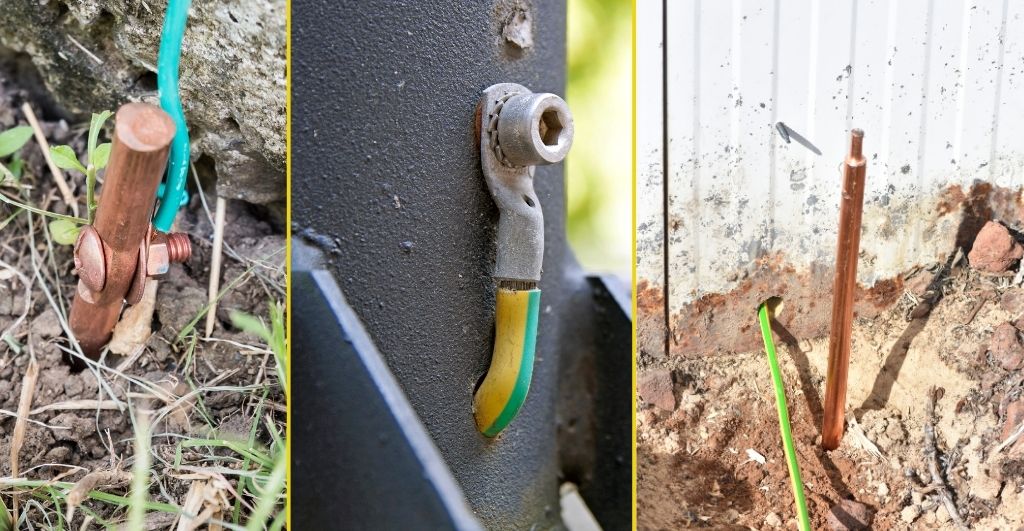
When Is Your Electric Fence Grounding Good?

During the early period when we were working with electric fences, it also became clear to us how many people neglect this critical element of electric fences.
Based on our outreach, most electric fence installers simply hammer in a single piece of rebar, or at best a steel pipe, into the ground as grounding.
If it has rained recently, this solution may even seem perfect. However, when installing electric fences, you need to think in terms of at least a one-year time frame, so you also need to pay attention to what kind of soil you are driving the probe(s) into and how deep you place them. We use the plural in parentheses because we have to admit that there are soils and grounding solutions where driving in one piece of iron at a single point may be enough, and the problem is solved. But in the vast majority of cases, either the soil or the probe is not suitable. In numerical terms, it looks like this: if you want to solve grounding with 1 probe, you need to think in terms of at least 2 meters of depth; if you are using 2 points, 1 meter depth is enough; finally, if you decide on the 3-probe system we also recommend, then half a meter of depth is sufficient.
Why is the material of the probes important?
We probably do not need to overexplain this either, since it is obvious that the elements driven into the ground should be made of a well-conducting metal. However, it also matters how long it stays that way. A piece of iron driven into the ground really does not rust too badly over a few months. But if you are planning for the long term, it is definitely worth using a grounding rod made of stainless steel.
That is because during rusting, the electrical resistance of steel increases by about a million times. This means that your grounding will definitely fail within 1, or in the case of little rainfall, 2 years if you do not use a non-rusting material.
Placing the probes
Think of a grounding system with multiple probes as a safety system. If one of them is placed where the soil is too rocky, or if someone accidentally catches on it and tears off the wire, the others are still there. In principle, during installation you need to keep in mind that there should preferably be no less than 5 meters between any two probes, and that they should be driven into compact soil rather than rocky ground.
We hope this short piece has helped you create the proper grounding for your electric fence system. If you have any questions, feel free to leave a comment. If you would like us to send you notifications about similar articles, subscribe to our newsletter in the block below!