What can a cheap rodent repellent do? We tested it!
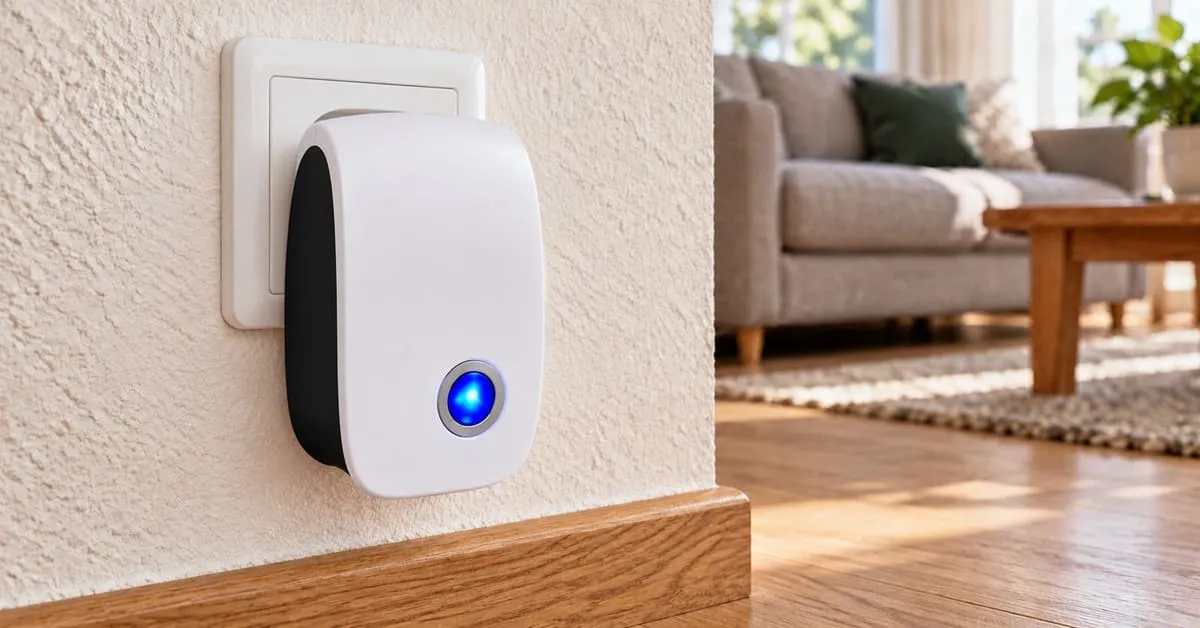
Since Vadalarm has existed, thousands of our customers have also asked us the question, "why are these so expensive" our rodent repellents. The short answer to that is usually that it’s because they really do what they say on the box. And that’s before we even get to our impeccably paid colleagues, proper customer service, fast fulfillment, and a reliable service background (yes, we still believe in non-disposable products). But so that we are not just talking in the air, we bought a cheap rodent repellent and then measured with an instrument what it actually emits.

The short result of the test: the device emitted a single one-second pulse every five seconds at 25.5 kHz. At around three meters, its ultrasound was already lost in the office background noise, so it could only effectively cover an area of about 14 m² at most. This is not a failure of ultrasonic technology, but rather the weak performance of a weak device.
Unfortunately, when reading the product’s webpage, we were quite skeptical, because it attributed capabilities to the product that we have repeatedly written lack scientific basis. To our knowledge, it has still not been proven that electromagnetic waves disturb rodents or mosquitoes. Of course, the unreasonably cheap Chinese webshops are driven not by a desire to provide accurate information, but only by quick sales.
Nevertheless, we still placed the order and waited. (By the way, they immediately threw in another one as a gift, so in effect one unit cost 5,000 Ft.) The delivery deadline was unfortunately quite long, 10 days (even though we ordered domestically), and payment could only be made in cash on delivery to the courier. Of course, this is still forgivable, although 10 days is somewhat long these days, especially if you have a rodent problem that requires immediate action.
But these are just details, if the product delivers what it promises. So let’s see how it performs!
As soon as it arrived, we began examining it critically. Please forgive us if we go into the small details here and there, but this is, after all, the field we work in, and what the average user might overlook could jump right out at us.

Let’s start with an unnecessary add-on
At first glance, it seems like a practical extra that they added a night light to the device. Unfortunately, the blue LED (at the top, behind the large transparent plastic element) is not the best choice for this purpose, since it is now a well-known fact that blue light disrupts sleep. At the very least, it gave us ideas about what more sensible(s) functions we could add to our own rodent repellents. Many people have also asked us why we don’t put a lit LED on our rodent repellents. Well, that is because many of our customers use their rodent repellent in places where they wouldn’t see it anyway, but it would definitely increase the risk of water ingress, even if only slightly.
How did we test the ultrasonic rodent repellent?
We carried out the measurement with the same sensitive ultrasonic microphone and software that we also use in our own product development. We monitored the device for more than 24 hours to find out:
- what frequency it operates at;
- whether it changes the emitted sound;
- how often and for how long it sounds;
- how the signal strength decreases with distance.
We measured the volume directly in front of the speaker, and then from 2.5 and 4.1 meters away. We did not compare impressions, but the device’s actual ultrasonic emission.
Measurement results of the cheap rodent repellent
| Tested characteristic | Measured result | What does this mean in practice? |
| Frequency | 25.5 kHz | The same sound repeated throughout the entire test |
| Operating cycle | 1 second of sound, 4 seconds of silence | It did not emit ultrasound for most of the time |
| Directly in front of it | –15 dB on the measurement system’s relative scale | There was a clear signal near the speaker |
| From 2.5 meters | –40 dB | The signal weakened significantly |
| From 4.1 meters | –60 dB | The ultrasound was already drowned out by the office background noise |
| Estimated coverage | up to about 14 m² | It can properly cover only part of a smaller room |
The biggest problem is not the 25.5 kHz frequency itself, but that the device always repeated the same monotonous, short signal. This creates a predictable environment for rodents. A effective repellent, by contrast, makes the protected area unpleasant with a strong and continuously changing sound pattern.

A large LED does not replace a large speaker
The tested device also received a blue night light. At first glance, this is a flashy extra, but from the perspective of rodent repelling it is secondary. The decisive component is an ultrasonic speaker of the right size and power.
When we took the casing apart, we found a small speaker. This exactly confirmed the measurement: the device worked up close, but after a few meters it ran out of power.

And what can the electromagnetic function do?
Although we still haven’t found antennas on the animals, so we don’t think any mouse is picking up public radio or even the waves of this product. Still, we wouldn’t be thorough enough if we didn’t examine the part of the product that generates electromagnetic waves as well. You can see the inside of the Chinese rodent repellent in the picture below. As is obvious, the developers did not hide a miracle weapon against rodents here either, since the circuit consists of nothing more than a fairly large coil and a few smaller components.
These components presumably serve to induce a small pulse in the two red wires. According to the "theory," this pulse spreads through the wall wiring and drives away rodents, as well as unwanted insects. Of course, the point of this remains highly questionable, since animals can detect sounds, but they cannot detect electromagnetic waves.
When choosing a rodent repellent, don’t look for electromagnetic, ionizing, or other flashy extra labels. The point is simple: how strong an ultrasound the device emits, how large an area it covers, and whether it changes frequency.
What makes an ultrasonic rodent repellent effective?
Four things determine whether the device will actually solve the problem:
- Proper ultrasonic power. The signal must reach the animals’ regularly used route; it is not enough if it only sounds right next to the device.
- Variable frequency and sound pattern. An unpredictable signal does not become familiar background noise for the animal.
- Correct placement. The speaker should face the protected area and the animals’ route, not be hidden behind boxes, furniture, or insulation.
- Continuous operation. The repellent keeps rodents away only if it is not switched on just occasionally.
Ultrasound travels in a straight line and does not pass through walls. This is not uncertainty, but an installation rule: every separate room or concealed route must be covered individually. Properly positioned, however, the device works directly where the mouse or rat moves.
Why is the Vadalarm rodent repellent more effective?
The Vadalarm ultrasonic rodent repellent emits randomly changing sounds between 17 and 27 kHz. Its high-power piezo speaker is designed for a range of 30–50 meters in open, unobstructed space.
Vadalarm does not simply emit ultrasound: with proper volume and a continuously changing frequency, it makes the protected area uninhabitable for rodents. This keeps mice and rats away effectively, without having to place poison or search for dead animals in the building.
If there is movement in the attic, we show the proper installation here: rodent repelling in the attic and loft space. If the noise is coming from inside the wall cavity, read this first: driving rodents out from behind plasterboard.
Short answers about the ultrasonic rodent repellent
Does the ultrasonic rodent repellent work?
Yes. An ultrasonic rodent repellent with sufficient power, variable frequency, and correct placement effectively keeps mice and rats away from the protected area. Our test showed that not every ultrasonic device has enough power for this.
Do rodents get used to ultrasound?
A weak device that repeats a single frequency can become predictable. Vadalarm’s randomly changing sound pattern between 17 and 27 kHz is designed precisely to prevent that.
Does ultrasound pass through walls?
No. The device must be placed in the same open space where the rodents move. Separate alarm points are needed for multiple rooms divided by walls.
Which rodent repellent should I choose?
For a smaller room, choose the Basic version; for a larger attic or warehouse, choose the Pro version; and for use far from a power outlet or for remote monitoring, choose the Smart version. If you are looking for a durable and effective solution, choose from Vadalarm rodent repellents. Click and check out the versions!
Lesson
This is not a product recommendation blog (it would be quite biased, after all, since we are writing as the manufacturer), so we are not going to say to buy or not buy this or that, or our own product. It is also important to stress that our goal with this article was not to unfairly disparage or put down the competition, but to carry out a comparative study based on instrument measurements. We wanted to back up with measurements what you can generally experience in the world: more expensive things (in our case the Vadalarm rodent repellents) are not more expensive by accident. They typically do more. If you have any questions about this, feel free to contact our customer service at +3618089079!
If, while reading any point, you felt that we were making technically unfounded claims, feel free to correct us by email (info@vadalarm.hu).