What should you know about the lifestyle of bats?

Although fewer people are afraid of bats today than in our grandparents’ time, many still have not taken a liking to these animals. Their strange appearance and nocturnal lifestyle do little to improve their popularity. At the same time, they are an important part of the ecosystem, and protecting them is of key importance in Europe.
Yet the truth is that these animals hardly pose any danger to people. The age of folk beliefs is over; it is time to set the record straight and get to know these remarkable creatures more closely, as they are currently on the brink of extinction. Let’s see how bats live their everyday lives!
How does a bat get by in the dark?
If someone is not familiar with them, it is only natural to wonder how they can navigate so well in the dark. The secret lies in sound. Bats emit ultrasound through their mouths, similar to our ultrasonic animal repellents, and use it to assess their surroundings. How? The sound bounces back from obstacles in its path, such as trees, rocks, and houses.
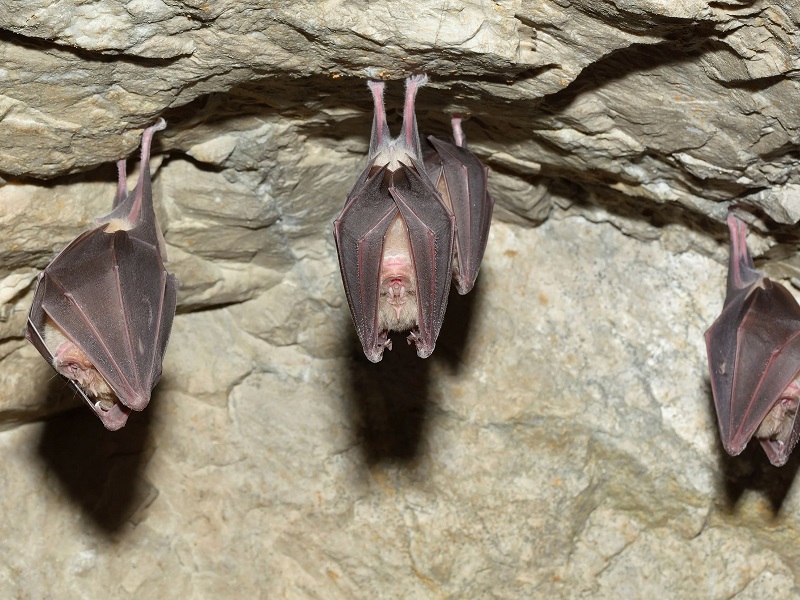
Of course, by itself this would not be enough for navigation. It is no surprise that most animals have better hearing than humans do. This is especially true of bats. It is no coincidence that their ears are so large. They use them to pick up reflected sounds, allowing them to avoid various obstacles even while completely blind.
This excellent hearing not only provides effective help with getting around, but also with hunting. Although there are species that feed specifically on fruit, most bats prefer insects. To find these tiny creatures, which mostly crawl on the ground or on plants, in the deepest darkness, they rely on the exceptional abilities of their ears.
Bats and Humans
Although bats would not be considered common residents of cities, they sometimes move into human spaces. Since they usually shelter in caves, hollow trees, and nest cavities, it is not surprising if they find the possibility of an attic or other protected crevices, where they can seemingly rest undisturbed during the day.
Old folk beliefs often associated them with vampires. In more modern thinking, most people now fear more the diseases they might spread. In reality, they rarely pose a threat to human health, and it is not very common for one to simply fly in through a window. If it does happen, it may be during the mating season or when changing roosts.
Nor is there any need to fear that it would attack a homeowner who suddenly appears upon discovering that a family of bats has moved into the attic. As mentioned above, these animals mostly feed on insects or fruit, depending on the species. Of course, there are some that truly feed on blood, but this is characteristic of only a few bat species, and they also prefer the blood of animals.
All specimens living in Europe are protected, with a notional value of around 100,000 forints. The reason is that their distribution is steadily declining, and in some species only a few individuals can still be found. These include the greater mouse-eared bat, the greater horseshoe bat, the lesser horseshoe bat, the Mediterranean horseshoe bat, the greater long-eared bat, the pond bat, and the long-winged bat.
The destruction of habitats and the decline of food sources are pushing more and more animals to the brink of extinction. Bats are no exception, so it is our task to protect and preserve them for the planet.