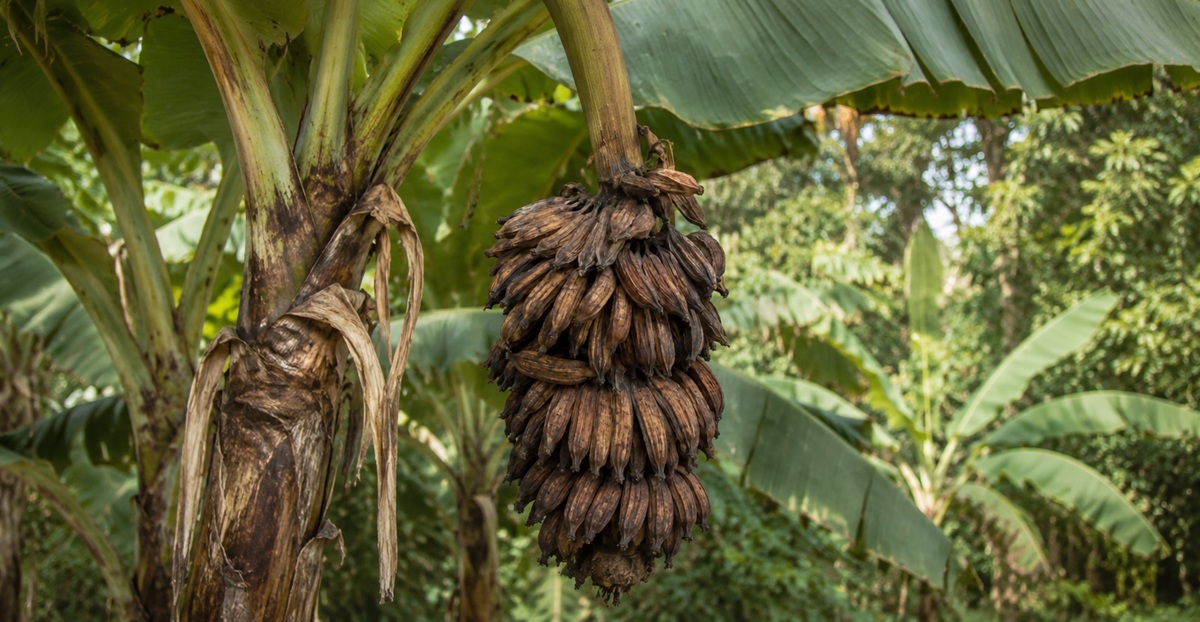
The bananas sold in stores today seem so ordinary that it is hard to imagine that one of the world’s most important fruits is in serious danger. This is not about all bananas disappearing from the Earth tomorrow. The real risk is that the current Cavendish banana, which dominates the export market, could suffer the same fate as its predecessor, the Gros Michel: its cultivation could become economically unsustainable.
What is destroying banana plantations?
The main enemy is Panama disease, specifically Fusarium Tropical Race 4, or TR4 for short. It is a soil-borne fungal pathogen that infects bananas through the roots, blocks the plant’s water- and nutrient-transport system, and then the plant withers and dies. TR4 is especially dangerous for Cavendish bananas, which account for about 90 percent of production, and in infected farms it can cause yield losses of up to 100 percent.
The problem is so serious because the Cavendish banana is essentially a global product made up of clones. The plants are not grown from seeds but propagated vegetatively, which means susceptibility to a disease can affect not just one variety or plantation, but entire regions.
Why is it so hard to stop?
TR4 is not a pathogen that can be dealt with by simple spraying. According to FAO experts, there is no real cure for banana Fusarium wilt; susceptible varieties would need to be replaced with resistant ones. Moreover, Cavendish accounts for about half of the world’s banana production, and there is currently no widely accepted, highly resistant substitute that growers and consumers would adopt immediately.
The fungus spreads insidiously. Symptoms may not appear for as long as 6–24 months, even while the pathogen is already present in the soil and water. Once it establishes itself in an area, it cannot simply be eradicated, because it can survive in the soil for decades.
Humans also play a major role in its spread: it can be carried from one area to another by infected planting material, on shoes, machinery, vehicles, soil residues, and even through water.
How badly are we losing?
The situation is serious, but not hopeless. According to IPPC data, TR4 has already been reported in 21 countries in Africa, Asia, Latin America, and the Pacific region. Bananas and plantains are grown in more than 135 countries and play a role in the food security of about 400 million people.
Latin America is particularly important because much of the bananas consumed in Europe and North America come from there, so ours do too. TR4 was first identified in Latin America in 2019, and since then countries in the region have been operating enhanced monitoring and prevention programs. According to the FAO, Colombia, for example, was able to slow the spread of the disease, and from the end of 2019 to the end of 2023 it managed to increase production and exports despite the presence of TR4.
Ecuador, one of the world’s most important banana exporters, officially reported the presence of TR4 in El Oro province in December 2025; according to the EPPO, the outbreak has the status of “not widely spread, under official control.” This is an important development because Ecuador is a key player in global banana trade. But let’s not have any illusions: given the trends, this situation cannot be sustained for long.
When is the banana apocalypse expected?
Of course, the banana as a plant will not go extinct in the foreseeable future. More than a thousand banana varieties exist, and many local types can still be cultivated. What is at risk is primarily the Cavendish as the cheap, mass-exported, uniform supermarket banana.
In the most realistic scenario, Cavendish will decline sharply in the 2030s. After all, TR4 is already present in several key regions, the fungus cannot be removed from the soil, and Cavendish is genetically very vulnerable. If the spread accelerates, then around 2035–2045 a serious market reshuffle could already take place: fewer classic Cavendish bananas, more alternative varieties trying to enter the market, and bananas in general will likely become more expensive because of stricter import and production rules.
Is there hope?
Yes. Solutions are coming from several directions.
In Australia, the genetically modified Cavendish banana called QCAV-4 has already received approval for human consumption, and according to the developers, it is virtually identical to the traditional Cavendish in appearance, texture, and taste, while carrying a gene that provides disease tolerance. It is important to know, however, that in this case the bananas that survive the banana apocalypse will already all be genetically modified.
In addition, the joint program of Chiquita, KeyGene, MusaRadix, and Wageningen University & Research introduced the Yelloway One hybrid, which is described as resistant to TR4 and partially resistant to Black Sigatoka. This is not yet a mass-market product: after the greenhouse phase, field trials will follow in the Philippines and Indonesia.
The solution is therefore likely not a single fungus-resistant banana, but several strategies working together: resistant varieties, gene editing, strict hygiene, sealing off infected areas, more diversified plantations, and getting consumers used to the idea that there is not just one kind of banana.
What can be done?
If we want to preserve Cavendish bananas, then we need to take clear steps: on the producers’ side, the most important thing is prevention, including disinfecting machinery, shoes, and tools, checking planting material, controlling water movement, and quarantining infected fields. Research shows that preventive and mitigating measures are economically justified as well, because the income and food security of infected producers decline significantly.
On the traders’ and consumers’ side, the most important thing is to expand the range of varieties. The current system is vulnerable because almost everyone wants the same banana: a Cavendish that is the same size, the same shade of yellow, and the same taste. If the market accepts more kinds of bananas, then growers can more easily switch to more resistant varieties.
Summary
Bananas will not go extinct tomorrow. But the future of the cheap, identical-looking Cavendish banana found in every store today is uncertain. The spread of TR4 is already a global problem, and because the pathogen can remain viable in the soil for decades, infected areas may be lost to conventional production for a long time.
A total extinction of bananas is therefore not a realistic scenario, but an economic crisis for Cavendish bananas in the 2030s is very much conceivable. If new resistant varieties, gene-edited solutions, and strict biosecurity spread in time, the crisis can be managed. If not, then over the next 10–20 years the banana market could be fundamentally transformed.