Just as plants take root in the soil in agriculture and horticulture, so too does grounding come from here in electric fences. Although at first glance it may seem like just a few metal rods, it plays a much larger role than you might think. In our current post, we will explore its functioning in more detail.
If you've ever dealt with electric fences or electrical wiring, you know that grounding is essential. However, many people aren't aware of the reasons behind this. When you think about it, it is a bit peculiar that a metal rod driven into the ground, possibly kilometers away from certain points of the fence, and connected to one output of the electric fence (essentially the grounding rod), can have such a significant impact on whether the electric fence shocks the animal.
To understand this, you first need to be familiar with the concept of voltage. We will try to summarize this for you in layman's terms. Think of voltage as the pressure in the tires of vehicles. This essentially means that in a certain space (inside the tire), there is more air than outside. This air wants to escape, but it is blocked by the tire. Voltage is similar, except instead of air, there are charges on a wire. And as incredible as it may seem, these charges also want to escape from the wire, but since air does not conduct electricity, they cannot.
And this is where the body of the animal or even a human comes into play, because while it may be slightly less efficient, it does conduct electricity. While the air escaping from a car tire knows exactly where to go (into the open), for the charges coming from the wire, it is not as clear where they should go. For a while, they can move to objects that touch the wire, but these objects will quickly become saturated too, and the charges need to go somewhere else from there. And this is where grounding comes into play.
You have probably heard the term circuit. From this, you can already guess why grounding is necessary. The current flows in a loop. When the electric fence device sends charges to the fence, it pulls them from somewhere: the ground. A closed circuit is when we return these charges back to where they came from. This can happen when a person or animal touching the fence allows the charges to flow through their body down to the ground. The circuit is completed as the current travels through the ground and back to the electric fence device via the grounding rod.
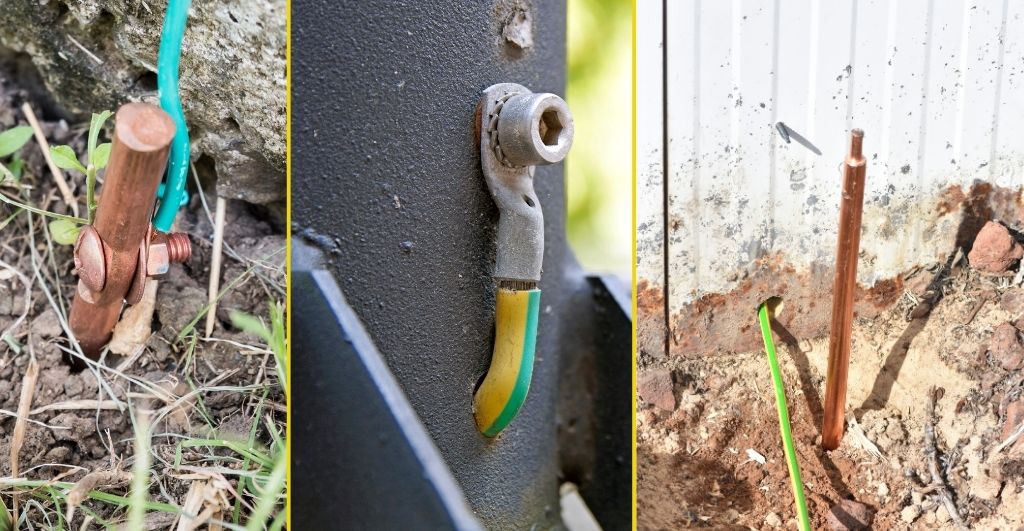
If you’ve had an epiphany, you can now understand the root cause of two common electric fence issues. Proper grounding is more effective when it makes better contact with the soil. This requires the use of materials with better conductivity over a larger surface area. Therefore, it is important to use a set of multiple grounding rods that are large and rust-resistant. These should be driven into well-conductive, preferably moist, and relatively rock-free soil for optimal grounding.
We also must not overlook the other significant consequence mentioned earlier. In some cases, the circuit closes through unintended paths. For instance, when the fence breaks or a tree branch falls onto it. In such cases, these elements can also draw charges away from the fence, leading to an almost complete loss of protection.
We hope we have covered the topic of grounding in sufficient depth, but if you have any questions, feel free to ask at info@vadalarm.eu! If you are interested in electric fence components, click here to find them!